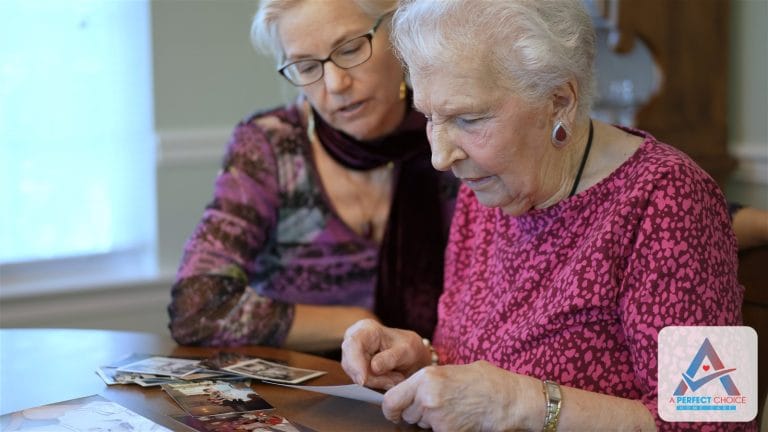

The early signs of dementia almost never show up the way people expect. Nobody calls our office because their mother failed a memory test. They call because the mail is piling up, or Dad told the same fishing story twice at lunch, or Mom, who cooked Sunday dinner for forty years, keeps a refrigerator holding little more than condiments and an expired quart of milk.
THE SHORT VERSION
- ✓The first signs of dementia are practical: repeated stories, unpaid bills, an empty fridge, skipped bridge games, getting lost nearby.
- ✓Watch direction and baseline: change over months, measured against who your parent has always been.
- ✓The early signs of dementia in women can stay hidden longer, covered by strong verbal skills and by everyone blaming stress.
- ✓Treatable conditions like medications, thyroid problems, and infections can mimic early dementia.
- ✓A doctor visit can check for the treatable imposters and gives your parent a voice in decisions.
We run a small, family-owned home care agency in Southwest Florida, and much of this job is sitting in living rooms and on lanais from Fort Myers to Sarasota while adult children tell us what they’ve been noticing. The details change house to house. The story’s shape rarely does. Something has been off for months, every little thing had an explanation, until one moment, a missed mortgage payment or a two-hour trip to a Publix ten minutes away, makes the pattern impossible to unsee.
WORTH KNOWING FIRST
Cards on the table. A Perfect Choice Home Care is a Florida-licensed home health agency providing one-on-one in-home care across Southwest Florida, licensed here since 2021. We are caregivers, not doctors, and nothing on this page is a diagnosis. If something below sounds like your mother or your father, bring it up at their next appointment. You do not need a plan first, or a theory, or the right words.
WHEN NOT TO WAIT FOR AN APPOINTMENT
Everything on this page is about slow change, measured in months. Fast change is a different problem. Confusion that comes on over hours or a few days, sudden trouble speaking or understanding speech, weakness or drooping on one side, a bad new headache, a fall or a knock to the head, or confusion with a fever alongside it, none of that is an early sign of dementia and none of it should wait for a scheduled visit. Call 911 or go to the emergency room. Delirium from an infection, a reaction to medication, or a stroke can look like dementia arriving overnight, and it needs care the same day.
The early signs of dementia families actually notice first
The Alzheimer’s Association puts “memory loss that disrupts daily life” at the top of its list of 10 early warning signs. Accurate, and not much use at a kitchen table. Here is what the first signs of dementia sound like when families call our office.
The same story, twice in one visit
Everyone retells a story a week later. What families describe is different: the same story twice in a single lunch, same details, same enthusiasm, no flicker of “stop me if I’ve told you this.” The second telling lands word for word because the first never got filed away.
The checkbook starts slipping
Late notices arrive. The same bill gets paid twice. A drawer turns out stuffed with unopened envelopes. Money is one of the first complicated skills to wobble, and a parent who ran the family books for fifty years will hide the struggle out of pride.
Weight loss and an empty fridge
Cooking is really a long chain of small decisions, and when the chain gets hard, people slide to toast, crackers, and cereal. Families notice the weight loss at Easter and check the refrigerator afterward: expired milk, condiments, freezer-burned leftovers. The fridge tells the truth even when a parent insists they’re eating fine.
Pulling back from bridge club, church, and old friends
When conversation gets harder to follow, many people withdraw before anyone works out why. The Thursday bridge group gets skipped, then church, then the calls with old friends get shorter. It reads as slowing down, and often that is all it is. It can also be someone quietly staying out of the rooms where the slipping would show.
Getting lost on familiar routes
We don’t mean getting turned around somewhere new in Naples. We mean losing the way to a grocery store they’ve driven to for fifteen years, or calling from a Cape Coral parking lot unsure which direction home is. That kind of drive is about as automatic as anything a person does. If it fails once, we would not wait for it to happen twice before bringing it up. If they’re still driving, it also helps to know how Florida’s Silver Alert works, since a statewide alert relies on details about the car, like the plate number.
New edges on an old personality
A mother who trusted everybody accuses the cleaning lady of stealing the purse that turns up in the freezer. An easygoing father snaps over nothing, or goes flat and drops the workshop. Suspicion and apathy show up early more often than people realize, and they’re the signs families take personally instead of seriously.
Normal aging or early dementia? How to tell the difference
Every adult child asks some version of the same question: how do I know this is more than getting older? Fair, because plenty of it is. The National Institute on Aging draws the same line in its guide to what counts as normal memory loss and what does not. A rough guide:
| Usually normal aging | Worth a conversation with the doctor |
|---|---|
| Forgetting a name that surfaces an hour later. | Forgetting whole recent conversations, not just details. |
| Misplacing the glasses, then retracing steps and finding them. | Putting things in strange places, then accusing someone of taking them. |
| Needing extra time with the new TV remote. | Struggling with an appliance they’ve used for years. |
| Occasionally reaching for a word. | Losing the thread mid-story. |
| Annoying, and normal. | Money mistakes in someone who was always careful. Steady withdrawal. |
Two things matter more than any single item: direction and baseline. One scattered afternoon means nothing. You’re watching for change over months, against who your parent has always been. A retired bookkeeper making bank errors is a louder signal than a lifelong absent-minded professor forgetting where he parked.
Early signs of dementia in women: why they can hide longer
Here’s a pattern researchers have written about, and one we hear echoed in the calls that come into our office. The early signs of dementia in women can go unrecognized longer than in men, for a few stacked reasons. It runs the other way too. The early signs of dementia in men can get written off as a short temper or plain stubbornness, so nobody raises those with a doctor either.
Part of it is verbal skill. Research on memory testing has found that women often hold on to word recall and conversational polish further into memory changes, so a mother can carry a whole family visit, or a ten-minute screening in an exam room, while losing ground underneath it. She sounds like herself, so nobody looks any harder.
Then there is the fact that every symptom already has an explanation waiting for it. A woman in her fifties or sixties says she has brain fog, or that she keeps reaching for words, and what comes back is menopause, stress, not sleeping. Often that is exactly right. It also makes a convenient shelf, and things sit parked up there for years.
And a lot of it is simply everything she runs. In most households Mom keeps the calendar, the birthdays, the prescriptions, the holiday dinners, all of it on lists and routines she set up long before anything was wrong. Those routines cover for her far longer than anybody realizes. We have heard several versions of the same Thanksgiving: a meal she had made for thirty years, coming apart in the kitchen, everybody standing around not sure whether to help or pretend they hadn’t noticed.
FROM OUR OFFICE
None of this is a diagnosis, and we’d be out of our lane pretending otherwise. It’s simply a reason not to wave off changes in a wife or mother because she still talks circles around everyone at dinner. If the pattern keeps building, raise it with her doctor, plainly and kindly. And if you want to talk it through with someone outside the family first, the Alzheimer’s Association runs a free 24/7 helpline at 800-272-3900.
What to do next: the doctor visit, and what it can rule out
Getting a parent to agree to go
When the change has been gradual, you have room to do this carefully. Leading with the word dementia usually slams the door. Smaller works better. Hang it on something already on the calendar, the annual physical, or the medication review nobody has looked at in three years. Say “I’d feel better if we asked about it” rather than “something is wrong with you.” Offer to drive. And write down examples with dates beforehand, the double-paid bill in March, the lost route in May, because parents can perform beautifully for fifteen minutes in an exam room, and the doctor needs the pattern from home.
Ruling out the imposters
This is the strongest argument for going even when you’re scared. Several treatable things mimic early dementia: medication interactions, thyroid problems, vitamin deficiencies, depression, untreated hearing loss. Mayo Clinic keeps a longer list of the causes that can be reversed. In older adults, even a urinary tract infection can cause sudden confusion that looks like rapid decline. That one is the exception to everything else on this page. Confusion that comes on over hours or days needs to be seen the same day, not slotted into next month’s calendar. A doctor can look for all of it, and sometimes the answer turns out to be a changed prescription or a hearing aid rather than a diagnosis.
Why early answers buy options
And if it is dementia? Finding out early is still worth it. Your parent gets a real voice in the decisions ahead: the paperwork, whether staying in their own home is realistic, what matters most as care needs grow. There’s also more time to get the medical side sorted, since a dementia diagnosis is rarely settled in one appointment. And the family gets to weigh choices like home care versus assisted living around a kitchen table instead of in a hospital hallway. In our experience the families who struggle most are rarely the ones who knew early. They’re the ones who found out in a crisis.
What early-stage dementia care at home looks like
Early stage does not mean round-the-clock care. Most families start with a handful of hours a week: breakfast, a medication reminder, a ride back to the bridge game she’d been skipping. Companionship care at this stage is partly practical help and partly keeping someone connected to their own life, because withdrawal feeds on itself.
As needs grow, that same relationship can deepen into structured Alzheimer’s and dementia care, with routines built around the person’s own rhythms. What a person needs does not hold still, and the stages of dementia lay out how those needs shift and roughly when care has to grow with them. Many families first notice real trouble in the late afternoon, restlessness and confusion as the light changes. It has a name, and our guide on what sundowning is explains what helps.
Not sure yet whether any of this adds up to needing help? Our checklist of ten signs an aging parent may need in-home care covers driving, falls, housekeeping, and the rest. And the usual next question: home care in Southwest Florida typically runs about 28 to 38 dollars an hour, and our home care cost guide breaks down what moves that number. Where the money comes from is a separate question, and how to pay for home care in Florida covers VA benefits, Medicaid, long-term care policies, and private pay.
One more thing, because it comes up on nearly every call. In the early stage the person carrying the most weight is usually a spouse or one adult child, and they hold out far longer than they should. A standing few hours of respite care each week, set up before anyone is desperate, is worth thinking about early, because caregiver burnout has a way of becoming the second problem a family has to solve.
Early signs of dementia: frequently asked questions
What are the first signs of dementia families usually notice?
Rarely the dramatic ones. Families notice repeated stories in a single visit, trouble with bills, weight loss and an empty fridge, withdrawal from friends and church, getting lost on familiar routes, and new suspicion or apathy. Each item alone can be innocent. The pattern over months deserves a conversation with the doctor.
What is the difference between normal aging and early dementia?
Normal aging looks like forgetting a name that surfaces later, misplacing glasses then finding them, and being slower with new technology. Early dementia looks more like forgetting whole conversations, putting things in strange places, struggling with familiar tasks, and steady withdrawal. The useful tests: is it changing over months, and is it a change from this person’s baseline?
Are the early signs of dementia different in women?
The signs are broadly similar, but research suggests they can stay hidden longer in women. Strong verbal skills can carry a conversation, and even a quick office screening, after memory has slipped, and early changes get chalked up to menopause or stress. If it keeps getting worse instead of holding steady, say so out loud at her next appointment, even if she waves you off.
Can something other than dementia cause these symptoms?
Yes. Medication interactions, urinary tract infections, thyroid problems, vitamin deficiencies, depression, and untreated hearing loss can all produce confusion or withdrawal that looks like early dementia. Several are treatable, which is exactly why the doctor visit is worth making even when you’re scared of the answer.
How do I get my parent to see a doctor about memory loss?
Skip the word dementia. Anchor the visit to something routine, like the annual physical or a medication review, offer to drive, and bring written examples with dates so the doctor sees the pattern rather than fifteen good minutes in an exam room. “Let’s rule a few things out” goes over far better than “something is wrong.”
What are the 10 early warning signs of dementia?
The Alzheimer’s Association keeps the list most doctors point to: memory loss that disrupts daily life, trouble planning or solving problems, difficulty finishing familiar tasks, confusion about time or place, trouble judging visual images and distance, new problems with words, misplacing things and losing the ability to retrace steps, poorer judgment, withdrawal from work or social life, and changes in mood or personality. Families almost never spot them in that order. They notice the unpaid bills, the empty fridge, the skipped bridge game, and only recognize the list afterward.
What does stage 1 dementia look like?
In the staging scales doctors use, stage 1 is the stretch where nothing shows at all. Changes have started in the brain, the person still functions normally, and a routine exam turns up nothing unusual. What most families mean by stage one is really the step after it, mild cognitive impairment or very early dementia, where the repeated question and the missed bill start showing up but daily life mostly still works. Nobody needs to wait for a stage number before writing things down.
How does your body warn you that dementia is forming?
Sometimes the earliest hints are physical rather than mental. Researchers have looked at a fading sense of smell, a slower or less steady walk, sleep that falls apart, and unexplained weight loss as changes that can show up years ahead of clear memory trouble. On their own they prove nothing. Plenty of people lose their sense of smell after a virus, and half the world sleeps badly. But when several stack up alongside the memory changes, say so at the appointment. Doctors want the whole picture, not just the memory part.
Is there a test for the early signs of dementia?
Not the online quizzes, no. In a real visit the doctor usually starts with a short cognitive screen, something like the Mini-Cog or the MoCA, that takes ten or fifteen minutes, plus bloodwork to check thyroid and vitamin levels and a review of every medication. Sometimes imaging or a neurologist follows. A screen is a starting point, not a diagnosis, and it works far better when the family brings written examples from home.
What is the number one trigger for dementia behavior?
There is not a single one, but ask caregivers and the same answer keeps coming back: change. A new routine, an unfamiliar room, too much noise at once, being rushed, or being asked a question the person cannot answer. Physical needs cause a lot of what looks like sudden agitation too, pain, hunger, thirst, needing the bathroom. So does plain tiredness late in the day, which has its own name, sundowning. Arguing rarely helps. Removing whatever set it off and slowing the afternoon down usually does.
Seeing some of these signs? You don’t have to sort it out alone.
A Perfect Choice Home Care has sat with a lot of Southwest Florida families at exactly this stage, from Fort Myers and Cape Coral to Sarasota and Bradenton. Call and tell us what you’re seeing. We’ll listen, tell you honestly whether home care makes sense yet, and if it does, we’ll walk you through what getting started actually looks like.
Call Fort Myers (239) 400-4514
Rather write than call? Send us a message and we’ll get back to you. A Perfect Choice Home Care, Florida-licensed home health agency. HHA 299995428 (Fort Myers) and HHA 299995533 (Lakewood Ranch).
Not sure what kind of help your family needs yet? That's normal.
Tell us a little about what's going on at home. One of our care team calls you back the same business day, listens, and gives you an honest read on whether home care would help and how many hours make sense. No pressure, and nothing to sign.
- Florida-licensed home health agency since 2021
- Free in-home care assessment
- Lee, Collier, Charlotte, Sarasota, Manatee and Hillsborough counties
Request a call back