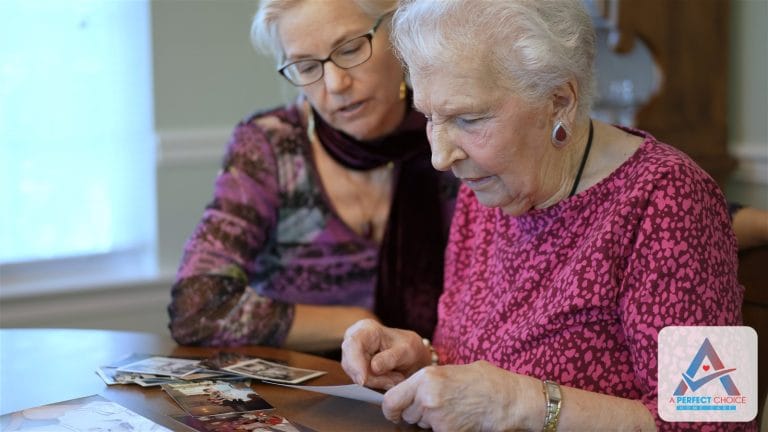
Sundowning is a pattern of confusion, agitation, and restlessness that shows up in the late afternoon and evening in many people living with Alzheimer’s disease and other dementias. Doctors call it sundown syndrome, and some families say sundowners. It is not a disease or a diagnosis by itself. It is a pattern, one that tends to build as daylight fades and ease by morning, and once you learn to see it that way, it becomes something you can plan around instead of something that ambushes you at 5 p.m.
If you’re reading this, you’ve probably already lived it. Mom is pleasant at lunch, a little foggy but herself. Then somewhere around dinner the mood turns. She paces. She asks when she’s going home, while sitting in the home she’s lived in for thirty years. By nine she’s exhausted and tearful, and so are you. Families across Southwest Florida describe some version of that evening slide. It’s common, it has a name, and there are practical things that help.
Quick honesty before we start. A Perfect Choice Home Care is a Florida-licensed home health agency (HHA #299995428 in Fort Myers, HHA #299995533 in Lakewood Ranch). Our caregivers are CNAs and home health aides who provide non-skilled, one-on-one care at home, including a lot of evening and overnight dementia support. We are not doctors and nothing on this page is medical advice, just the practical knowledge caregivers pass to each other. Your loved one’s physician should always have the final word.
Sundowning symptoms: what the evening slide looks like at home
Every person is different, but the behaviors families report are remarkably consistent. If several of these show up mostly in the late afternoon or evening, and mornings are noticeably better, you’re likely looking at sundowning:
- Pacing, wandering, or repeatedly trying to leave the house around dusk
- Asking to “go home” while already at home, or insisting on a long-gone routine like picking the kids up from school
- Shadowing, following you from room to room and growing anxious when you step away
- Suspicion and accusations, hidden purses, stolen keys, strangers in the house
- Irritability or tearfulness over small things that wouldn’t have registered at noon
- Seeing shapes or people in dim corners, often where shadows fall
- Trouble settling for dinner or bed, then being wide awake at 2 a.m.
The timing is the tell. A parent who is confused all day at roughly the same level is dealing with dementia’s baseline. A parent who reliably comes apart between late afternoon and bedtime is sundowning on top of it.
Why evenings are harder for someone with dementia
Nobody can point to a single cause, but the accepted picture has a few overlapping pieces, each suggesting something you can do about it.
The body clock drifts. Dementia can wear down the internal clock that tells the brain when it’s day and when it’s night. Cues most of us don’t think about, bright morning light, mealtimes, activity, do a lot of the work of keeping that clock set. When the cues get weak, evening and night start to blur.
The day’s fuel runs out. Living with dementia is exhausting. Every conversation and every attempt to make sense of a room takes effort. By late afternoon the reserves are spent, and the patience that got your dad through the morning simply isn’t there anymore.
Low light makes rooms harder to read. As natural light drops, shadows deepen and familiar objects turn strange. A bathrobe on a door hook can become a person. For a brain already struggling to interpret what it sees, dusk raises the difficulty on everything.
Evenings are noisy. Dinner prep, the TV news, family coming home, phones ringing. What feels like ordinary household bustle to you can land as chaos for someone whose filter is gone. Add hunger, thirst, or pain they can no longer describe, and the fuse gets very short.
Sundowning in Southwest Florida: what’s different here
Most sundowning advice is written as if everyone lives in the same climate. We don’t, and a few local realities genuinely change the picture.
Winter sunsets come early. In December and January, the sun is down before 6 p.m. here, so the sundowning window collides head-on with dinner prep, the busiest and loudest hour of the house. Families often notice rougher evenings in winter and assume the disease has jumped ahead, when part of it is simply the earlier dusk.
Summer heat traps people indoors. From June through September it’s often too hot for an older adult to spend real time outside, so the daylight that anchors the body clock quietly disappears. And when a 3 p.m. thunderstorm turns the house dark, some people start sundowning hours early. Turn the lamps on when the storm hits, not after. Our caregivers from Sarasota down to Naples often build a morning lanai hour into the care plan for exactly this reason.
The lanai is your secret weapon. Most homes here have a screened porch, and it’s the easiest daylight dose in Florida. Morning coffee on the lanai, before the heat builds, gives the brain a strong “it’s daytime” signal with no car ride and no sunburn.
Hurricane season scrambles routines. Shutters that darken every room, a power outage that kills the lamps and the AC, a few nights at a relative’s house or a shelter. Any one of these can set off days of worse evenings. You can’t stop the storm, but you can keep the daily rhythm as steady as possible, stock battery lanterns and nightlights, and expect a rocky week afterward instead of being blindsided by it.
How to help with sundowning: what actually works at home
None of this is a cure, and no single trick works for everyone. But stacked together, these habits take the edge off most evenings.
Front-load the light and the activity
Get bright light early: lanai time in the morning, blinds wide open, a short walk before the heat. Schedule anything demanding, bathing, appointments, visitors, before midday when reserves are highest. A tired body settles at night; a bored, under-stimulated one often doesn’t.
Keep the schedule almost boring
Same wake time, same mealtimes, same bedtime, every day including weekends. Predictability is calming when memory can’t fill the gaps. Keep naps short and early in the afternoon, and go easy on caffeine after lunch, which includes the sweet tea, not just the coffee.
Turn the lights on before the sun goes down
Don’t wait for dusk. An hour before sunset, turn on lamps, close the blinds so windows don’t become black mirrors, lower the TV, and let the household volume drop. Nightlights in the hallway and bathroom help with the 2 a.m. wake-ups, when a dark hallway can be genuinely frightening.
Redirect instead of correcting
This is the one that changes households. When your mother says she needs to get home to make dinner for children who are now in their sixties, arguing the facts almost always makes things worse. She can’t hold the correction, but she absolutely feels the conflict. Respond to the feeling instead: “You’ve always taken such good care of everyone. Dinner’s handled tonight. Come help me fold these towels.” Experienced caregivers also lean on a pause, sometimes called the 90 second rule, which we unpack in the FAQ below. And when a whole evening goes sideways anyway, forgive yourself. Some nights just do.
When to call the doctor
Gradual evening restlessness that follows a familiar pattern is one thing. A sudden change is another. If confusion or agitation gets sharply worse over a few days, spreads into the daytime, or arrives with fever, pain, falls, or big changes in appetite or bathroom habits, call their physician promptly. In older adults, something as ordinary as a urinary tract infection, dehydration, or a new medication interaction can look exactly like dementia taking a nosedive, and those causes are treatable.
Even without a sudden change, loop the doctor in about sundowning itself. Keep a simple log for a week or two, what time the agitation starts, what set it off, what helped, and bring it to the next appointment. It gives the physician far more to work with than “evenings are bad.” And to say it plainly one more time: we’re a caregiving agency, not a medical provider. Diagnosis and treatment belong to their doctor.
How one-on-one evening help changes the picture
Sundowning lands hardest during the exact hours a family caregiver has the least left to give. You’ve worked all day, or you’ve been on duty since 6 a.m., and now comes the hardest shift. That’s why so much of our Alzheimer’s and dementia care is scheduled in the afternoon and evening. A caregiver who arrives at 3 or 4 p.m. can run the whole wind-down playbook, the lights, the quiet, the early dinner, the redirection, with the patience of someone who hasn’t already spent ten hours on duty. The same familiar face each visit matters enormously to someone with dementia, and we build our schedules around that.
For some families, the biggest gift is simply a break. A few protected hours a week of respite care lets you sleep, see your own doctor, or eat an uninterrupted meal, and come back to the evening with something left in the tank. When the 2 a.m. wandering starts, overnight shifts or around-the-clock care at home can keep your parent safe in the place they know best while the rest of the house actually sleeps. And if your parent ever does slip out the door, our guide to Florida’s Silver Alert covers what to do in the first 15 minutes.
A Perfect Choice Home Care is a Florida-licensed home health agency, HHA #299995428 for our Fort Myers office and HHA #299995533 for Lakewood Ranch. Our license covers non-skilled, one-on-one care delivered by CNAs and home health aides: personal care, companionship, dementia support, respite, and overnight help, not nursing or therapy. We serve families across six counties, from our home base in Fort Myers up through the Sarasota and Bradenton area.
Sundowning: frequently asked questions
What is the 90 second rule for dementia patients?
The 90 second rule is an informal caregiver rule of thumb, not a medical protocol. When someone with dementia becomes agitated or upset, instead of immediately correcting or arguing, you pause for about 90 seconds: stay calm, keep your voice low, don’t debate the facts, and let the emotional surge crest and pass. Then you gently redirect to something else, a snack, a photo album, a small task. The idea borrows from the popular observation that the body’s initial rush of an emotion fades within a minute or two if nothing feeds it. Arguing feeds it. Patience and redirection usually don’t.
Is sundowning a sign dementia is getting worse?
Not by itself. Sundowning is common in the middle stages of Alzheimer’s and other dementias, and its arrival or a rough patch of evenings doesn’t automatically mean the disease has progressed. Seasons, routine changes, poor sleep, and stress can all make it flare. What deserves a prompt call to the doctor is a sudden, sharp worsening over days, since infections, dehydration, and medication issues can mimic a decline and are treatable. Mention any lasting change at the next appointment either way.
What time does sundowning usually start?
Most families see it begin in the late afternoon, often between 4 and 7 p.m., and it can run into the night. The window shifts with the light: on Florida’s short winter days it can start noticeably earlier than in June, and a dark stormy afternoon can trigger it ahead of schedule. Tracking your own loved one’s pattern for a week tells you more than any general rule.
Does sundowning happen every night?
No. Many people have hard evenings some nights and quiet ones others, and the difference often traces back to the day: how much light and activity they got, whether they napped too long, whether the routine got disrupted. That’s actually good news, because it means the daytime habits families control, morning light, steady schedules, calm evenings, genuinely move the needle.
Can sundowning happen in the morning?
Usually it is a late-day pattern, which is where the name comes from, but some people do get confused or agitated in the morning instead. Early confusion can point to a disrupted night, poor sleep, or an underlying issue like an infection or a medication side effect, so it is worth mentioning to the doctor rather than assuming it is ordinary sundowning.
What does sundowning mean in medical terms?
In medical terms, sundowning describes a pattern of increased confusion, agitation, or restlessness that appears in the late afternoon and evening in people with dementia or Alzheimer’s disease. It is not a separate diagnosis. Clinicians treat it as a group of behavioral symptoms tied to the time of day, which is why a steady daily routine matters so much in managing it.
The evenings don’t have to fall on you alone.
If sundowning is wearing your family down, talk it through with us. We’ll listen to what your evenings actually look like and tell you honestly whether a few afternoon hours, an overnight caregiver, or something else entirely makes sense. The conversation costs nothing.
Lee, Collier & Charlotte counties (239) 400-4514 · Sarasota, Manatee & Hillsborough (941) 799-7559 · or send us a message and we’ll reach out.
Not sure what kind of help your family needs yet? That's normal.
Tell us a little about what's going on at home. One of our care team calls you back the same business day, listens, and gives you an honest read on whether home care would help and how many hours make sense. No pressure, and nothing to sign.
- Florida-licensed home health agency since 2021
- Free in-home care assessment
- Lee, Collier, Charlotte, Sarasota, Manatee and Hillsborough counties
Request a call back